Monday, 11 November 2013

Meet Santa's Helpers

Over the half term break, I went on a trip to Scotland with my exchange program and one of the coolest things we did while we were there was to visit the Cairngorm Reindeer Centre in Aviemore. If you’re an outdoorsman, an animal lover, or just looking for a fun weekend trip, definitely check this out.

The journey starts at the bottom of a hill where you are met by guides who are reindeer experts. Then begins a short hike through the woods. The paths are small and sometimes a little intimidating but the stunning views of the mountains and valleys all around more than make up for it. After crossing a beautiful stream,and walking a bit further, you finally arrive at the first reindeer enclosure. At this point the guides will go over some basic rules and then you go in!

This is a very interactive experience. The reindeer understand that when people show up, they are going to be fed, so don’t be alarmed if they start following you or coming right up onto the path with you. Once you have reach the designated spot within the enclosure, the guides start putting out the regular food. While the reindeer are away eating that, you have the chance to take a handful of different food to give them as a treat.


They say in Harry Potter that “The wand chooses the wizard,” well, in this case it is “The reindeer chooses the human.” You can try to pick a favourite and get them to come to you, but most of the time they won’t pay attention. All of the reindeer are very friendly, and since reindeer don’t have any top teeth they can't bite, so the only things you really must be mindful of are the antlers.


I went in mid-October when the leaves were just starting to change colour and it provided some of the most beautiful scenery I’ve ever seen. But as reindeer tend to be associated with winter, and especially with Christmas, this trip would also be lovely for a family with children to go on together to help get into the holiday spirit. Really though, this is a trip for everyone. You’d have to be a real Scrooge to not enjoy it!

Written by Audi Craig. Audi is an American studying in London. She is working as a Intern at FOCUS.


For more information about FOCUS visit: www.focus-info.org

Thursday, 7 November 2013

The value of the IB Diploma from the perspective of an IB - DP Alumni

The International Baccalaureate (IB) Diploma Programme (DP) is a really interesting curriculum; with the premise being that an IB student can change school and pick-up the programme right from where they left off, whilst simultaneously developing highly adaptive individuals.

Personally I'm not one of the "3rd Generation" kids that lived in multiple cities whilst growing up, but the benefits of the IB weren't lost on me. Due to the vastness of the cultures I had to interact with throughout the Primary Years Programme, Middle Years Programme and Diploma Programme as well as the open-minded principles the IB ingrains in it's students, I developed a sense of cultural awareness that has incalculable value. At the age of 23 I've worked in Angola, Portugal, USA and the UK, and in all countries I felt prepared to interact with the local culture. Not that I knew everything about that particular culture, but I had the inter-personal skills required. Skills that I believe are only developed through experience, and the IB Programmes provided me with just that.


Reality has changed, and the idea of a 'single culture' individual is one that is quickly fading. The paradigm of success is continuously changing - faster than ever - and the most important thing for any student is to pick up the skills that allow them to adapt to this ever changing reality.


The other advantage I've felt, and one I can honestly say is a competitive advantage, is from a 'work ethic' perspective. Many students that go through the IB-DP complain about the workload, and rightfully so. No matter how much work I have to do for my day job, I can honestly say that in relative terms the IB-DP is the single hardest thing I've ever done. An opinion I'm sure is echoed by many IB students around the world. But it isn't all doom and gloom. This forces us to develop mechanisms to handle large workloads with short lead times, and to do so at a very high quality. Something which no doubt is valued by any industry. Combine this with the sense of curiosity that most IB students develop and you're left with highly effective and innovative individuals.

I guess by now you're all wondering why I'm sharing this or that 'surely the IB can't be that great?' You're right, it isn't all glamour. It is an extremely challenging programme that not all students benefit from as they find it overwhelming. However, even though as an alumni I'm biased towards the IB Diploma, I see daily the benefits that having gone through the programme bring me. As such, if writing this post can in any way help a parent or student decide whether (or not) to pursue an IB Diploma, then it was worth writing.

Author Bio: Francisco Moreira graduated from Hult International Business school with a Masters in International business and works as a Business Analyst in Offerings Management at CSC based in London, United Kingdom. Francisco is the author of Find Your Rhythm, (www.findyrhythm.com) a self-help guide for International Baccalaureate Diploma students.


Tuesday, 29 October 2013

....PUBS UP!!


Every expatriate in London must have felt the desire to immerse himself or herself deeply in this great city’s life and soul!   What better way than a drink in a pub to get a grasp of it? Sadly pubs are disappearing everywhere in the country…


The Grenadier in Wilton Row, Knightsbridge
Well, for those who are ready to dive in… a pint of beer, a glass of wine or… engage in a ghost chase, there is a public house called The Grenadier which will offer all of these thrilling experiences.


The Grenadier signboard
Tucked away from hectic Knightsbridge, hidden in a Belgravia cobble-stoned mews with an air of a country village, The Grenadier welcomes the visitor with its bright red and blue colours, its vermilion entry box and its signboard picturing… a proud grenadier!


Inside, the main room is small and cosy, with wood panelling and a low ceiling, and there is a big bar with the original pewter top.  A few sabres, a bugle and other military objects remind the visitor that The Grenadier was originally built for the First Royal Regiment of Foot Guards in 1720.  At that time, it was the Duke of Wellington’s Officers’ mess, and drinking and gambling were performed in its cellar.  In 1818, it became a licensed public house, “The Guardsman”, before being named “The Grenadier”.


Sausages and mash
Freshly cooked traditional pub food such as fish and chips, burgers, sausages and mash and of course the “Sunday Roast” are served in the main room or, for more privacy, in the rear dining area. A large selection of wines from around the world (Chili, Spain, Italy, New Zealand, Argentina, Australia, etc…), ciders, and ales can accompany a “traditional British” meal.


Inside The Grenadier
 An old and honourable institution indeed…  But what makes The Grenadier very special is its fantastic lodger from a by-gone age: the ghost of a young soldier who, one sinister night in September of a long-lost year, was caught cheating at cards and beaten to death by his fellow-players. Every September since, a tall, silent shadow has been seen, wandering endlessly in The Grenadier, filling the otherwise cheerful rooms with a strange chill or a soul-tormented sigh. Weird tales have been heard: a Chief Superintendent from New Scotland Yard was once burnt by an invisible cigarette as he was trying to reach what seemed to be the source of smoke he could see…Anxious footsteps have been heard on stormy nights… A face appeared behind a window…


Do not hesitate to go and enjoy a glass of wine while waiting for the spirit of the place. A crispy, chilly glass of Chablis – Domaine Thierry Mothe, another “old and venerable” institution - will undoubtedly hasten the strange encounter!

Written by FOCUS member Florence Tilkens.

For more information about FOCUS visit: www.focus-info.org

Monday, 21 October 2013

The Pursuit of Beauty


What is it that drives the antique collector? Is it more than just the hunt? The hunt needs to have a purpose. I believe it is the pursuit of the beautiful, that satisfaction of having an object touched by hand and made with imagination that speaks to the soul. 

LAPADA, the Association of Art and Antique Dealers held its 5th annual fair at Berkley Square at the end of September.  This Fair has become an essential visit for those in the pursuit of beautiful things: the pieces of furniture, textiles, silver, ceramics or art that will add to your collections. Because many of the dealers come from outside London, it is a chance to see the best the country has to offer.

When I visited the fair I saw many of the loveliest pieces from collectors and dealers. Being a designer, I find endless inspiration from fairs like LAPADA. It gives me a chance to see pieces of work that are usually only seen in museums. But throughout years that I have been advising on art and antiques I can’t help but notice even antiques go through fashions. 


This year I noticed less Gustavian influence and more of the rich, warm and mellow mahogany furniture from the 18th and early 19th centuries. Graceful and elegant, these pieces of furniture are always an investment, but make such a statement in a home or office. Early 20th century and modern pieces are still favourites though, with smooth lines and soft colours.


When I was a kid, fashion illustrations were some of the first drawings and designs that caught my eye in newspapers when I was a kid. They have been a favourite of collectors, starting with Erte, in the early 20th century. This show had the original illustrations by Eva Aldbrook which were commissioned by The Sunday Times fashion pages in 1956. They were shown by Gray Modern & Contemporary Art and this was the first time they have been seen since publication… very exciting. It was a delight to see them, the fresh lines, shapes and watercolours all created that elegance of 50's glam. 

As I looked at them I couldn't help but think of fashion illustrators today working on Illustrator and Photoshop, what will we have in the future? We’ll have to look into a crystal ball to find out!

Written by Kelly Fannon who writes for the FOCUS Magazine and who has a passion for antiques, art and interior design. 

For more information on Focus visit: www.focus-info.org

Thursday, 10 October 2013

Review of Pearls: V&A and Qatar Museums Authority Exhibition


Exhibition open until 19th January 2014 at V&A.

The C&A Pearls Exhibition
I would highly recommend a visit to the latest remarkable exhibition of Pearls at the Victoria and Albert Museum. On display is an enormous collection of multi coloured natural pearls including the pink conch pearl; brown, black, blue green abalone pearl and the orange Melo pearl. Any mollusk with a shell can produce a pearl.  


Natural oyster pearls have been fished in the Arabian Gulf from the earliest times until the 1950s using the same methods of diving to a depth of 22 metres. It takes 2000 oysters to produce a suitable pearl for use in a piece of quality jewellery. As you look at the magnificent five row natural Gulf pearl necklace made by Cartier from the 1930s, you can appreciate the time taken to collect the pearls which need to be matched according to scale and lustre.

Grand Jete, gold with diamonds and two cultured baroque pearl
Pearl trading in the Gulf, from Saudi Arabia to Dubai, Bahrain to Qatar, started as early as the 7th Century where Arab merchants crossed the Indian Ocean to India. Chinese merchants also travelled to India to find highly prized natural pearls from the Gulf. By the early 19th Century the Arabian Gulf was the major global supplier of natural pearls. At their height, the great jewellery houses of Europe sought the best quality oriental pearls between 1850 and 1930. Today the natural pearl has become a prized rarity.

Gold hair ornament, Roman, 3rd Century AD
From Roman times to Medieval Europe pearls symbolized wealth and status. Gorgeous Renaissance jewellery examples abound, set with multi coloured gemstones such as garnets and rubies alongside pearls and richly enamelled gold pendants. There are beautiful examples of late Victorian diamond and pearl brooches and Art Nouveau jewellery, some by Lalique and Vever, showing designs of plants and insects, in gold, enamel and horn sculpted into natural forms. There is also a pearl sautoir necklace worn to the waist amid the 1920s fashionable flapper dresses. There are incredible examples of seed pearls beautifully sewn into jackets and dresses, even one worn by Her Majesty the Queen!

Rosebery pearl and diamond tiara dated 1878
The highlight of the exhibition for me personally was the wonderful collection of pearl and
diamond tiaras. In particular, the Rosebery pearl and diamond tiara dated 1878 with natural
bouton and drop shaped pearls, set in silver and gold surrounded by old cut diamonds. There is even jewellery from the Hollywood stars: a pearl necklace worn by Marilyn Monroe and a pearl and diamond ring that once belonged to Elizabeth Taylor!


Kokichi Mikimoto (1858-1954) in Japan developed a patent for making round cultured pearls from Akoya oysters at the turn of the century which heralded the start of industrial production and in the 1950s cultured pearls were at their fashionable peak. There are South Sea cultured pearl necklaces in many colours, the finest produced by Pinctada Maxima oysters farmed in Burma, Indonesia, Thailand, the Philippines and Australia. There is a stunning necklace by Yoko, London incorporating these multi coloured cultured pearls from the South seas set in 18 carat white gold with diamonds. This is a beautiful and unusual collection which is open daily and well worth a visit!


Written by FOCUS member Gemma Darlington FGA, Jewellery specialist and gemologist of Gems Fine Jewels www.gemsfinejewels.co.uk
 
For more information about FOCUS visit: www.focus-info.org

Thursday, 3 October 2013

A walk in the park

We all know that London is a major player in the world art scene, so the opening of a new gallery is always exciting. Being located in the very beautiful and popular Kensington Gardens is an added attraction and lends itself to a great family day out.
 
Serpentine Sackler Gallery
Located on the north side of the Serpentine lake, the new Serpentine Sackler Gallery opened on 28th September with an installation by Argentine artist Adrian Villar Rojas. The original building, known as The Magazine, has had various uses throughout its history, but was built in 1805 as a gunpowder store – look up for the stained glass windows in the main room, created by Rojas. A very modern addition has been designed by Zaha Hadid (incidentally, she designed the aquatics centre for the London Olympics) and hosts a restaurant which is open for breakfast, lunch and dinner. There is a great contrast between the pre-Victorian Magazine and the ultra modern restaurant – I found both spaces very interesting on their own, but also together.

The Serpentine Gallery Pavilion 2013 by Sou Fujimoto.
A short stroll away is the original Serpentine Gallery.  Built in 1934 as a Tea Pavilion, it began life as a gallery in 1970 and is currently showing the works of Marisa Marz. There has been an annual outdoor ‘Pavilion’ designed and built in the adjoining garden since 2000. This is a temporary structure which is designed by an architect who has not previously worked in Britain. Given that this is temporary, there is a new structure every summer, and usually hosts an outdoor café. My son took great pleasure in climbing to the top of what looks like something he created from a magnetic construction set!

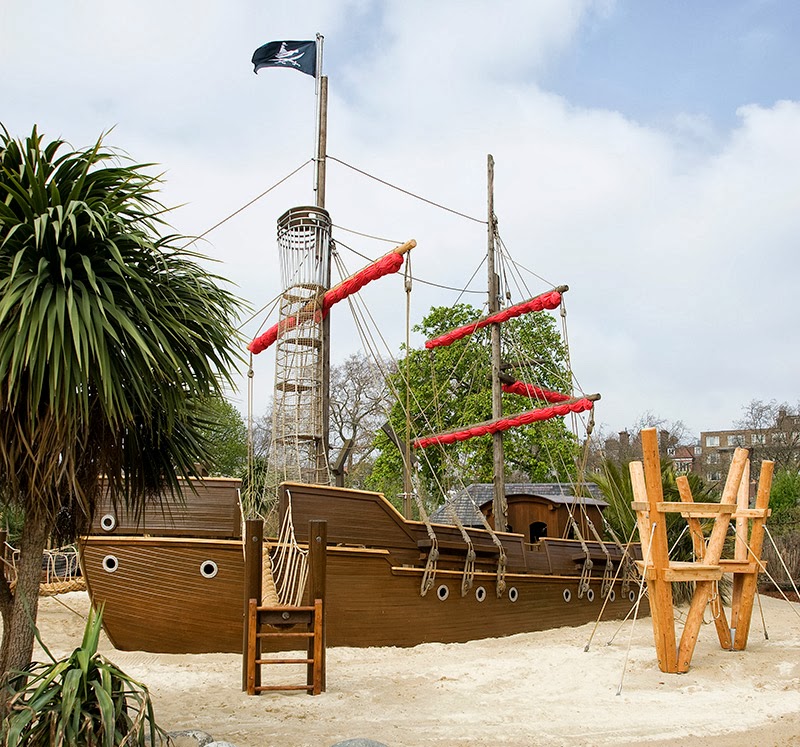
Both galleries are very small, and are ideal for even the youngest children who might have a short attention span. Having two energetic boys, I can vouch for this first hand. Of course, there are so many attractions in the park that they too can choose from a variety of activities. There is the Diana Memorial Playground located in the northwest corner of Kensington Gardens. Kids can let their imaginations run wild with a pirate ship, teepees, hidden walk ways as well as toys and play sculptures, and we have spent hours there.  A word of warning – trying to extricate your kids from the playground may be a trying experience! The Round Pound has a large population of ducks, geese and swans, my boys like to bring along stale bread to feed the local wildlife. 
Diana, Princess of Wales' Memorial Playground
Diana, Princess of Wales' Memorial Playgrou
Also nearby is Kensington Palace, Queen Victoria’s birthplace and the current home of the present day Prince William. The Duke and Duchess of Cambridge, as they are also known, have set up residence in the palace with their son Prince George of Cambridge. Recently renovated, the public entrance has been transformed, and you can visit the King’s State apartments, the Queen’s State apartments and the gardens. 

There are many more things to do and see, so put on your walking shoes and head for the park!

Written by Eva Stock
For more information about FOCUS visit www.focus-info.org

Thursday, 5 September 2013

Daytime Date

 
Our daughter started back at school last week ... and her dad and I played hookie; mitched; played truant – whatever you like to call it  when you really ought to be at work or school but decide to go off piste.


It was a date. And all the better for being a little bit naughty and unexpected.  Since her very first day at her very first school, “Dad” has taken the morning off work to walk the daughter in to school - a family ritual to start the school year.  He holds her hand all the way, gives her sound advice, a big kiss and sends her off.  This year, as she is 16, he compromised on the hand-holding bit and let go at the corner.  She scooted in before the kiss but ran back out again, a sucker for tradition, and grumpily proffered her cheek when no one was looking.

And there we were.All dressed up at 8.30 am with nowhere to be in a hurry.  The sun was shining and the sky was blue.  So off we scooted to breakfast at St. Paul’s while harried city folk rushed into overheated offices. We sauntered over the bridge to Tate Modern, caught a couple of exhibitions early, beating all the crowds and, as a really special treat, took the River Bus Tate-to-Tate, to catch the Lowry at Tate Britain.
L.S. Lowry Flowers in a Window 1956
We were all done by lunchtime, the husband set off to meetings feeling virtuous, cultured, daring and relaxed.  I totally recommend it.  The date part and the boat along the river which allows you to avoid all that messy business on the underground until you have to rejoin the real world and really get back to work. Have a look at the current FOCUS magazine for many more ways to travel by river.

In fact, it was such a success that I am considering starting a new tradition in our family. A monthly date.  I might have to work on getting the daughter to agree to the hand-holding into school though.  She will be 17 in November...

Written by Jan Winter
For more information visit www.focus-info.org